








Let’s get something out of the way first: body shape categories are a starting point, not a sentence. The whole point of knowing your shape is to understand your proportions so you can dress intentionally. It’s not about hiding anything or chasing some ideal silhouette. It’s about making clothes work for the body you actually have, right now.
With that said, let’s get into it.
The Shapes
Triangle
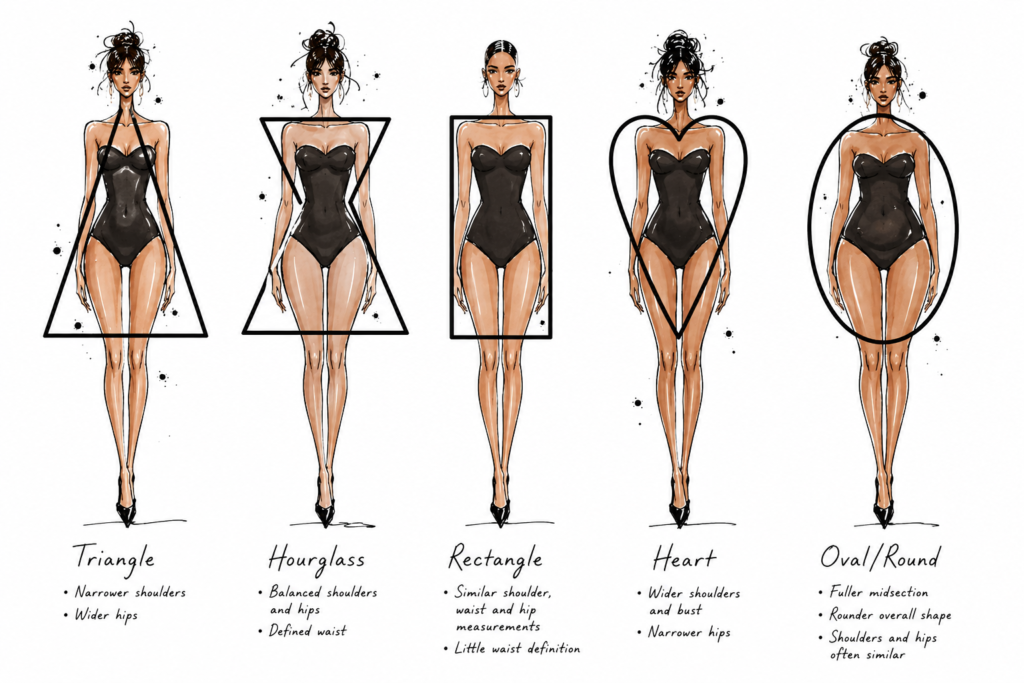
What it looks like: Shoulders are narrower than the hips, with a defined waist and a fuller lower half. 
Why it can be tricky to style: Most clothing is cut with a straighter silhouette in mind, so if something fits your hips, it’s usually too big on top. You’re essentially shopping for two different size ranges at once. That’s a tailoring problem, not a you problem.
How to dress it:
- Add visual interest to the upper body: embellished necklines, off-the-shoulder, puffed sleeves, bold prints on top
- A-line and flared skirts that skim the hips without squeezing
- Dark, solid colors on the bottom; bolder choices on top
- Structured jackets and blazers that add shoulder definition
- High-waisted pants with a wide leg
What to avoid:
- Tapered or skinny bottoms that exaggerate the hip-to-shoulder difference
- Cargo pockets, ruffles, or heavy embellishment at the hips
- Clingy fabrics around the lower half
Hourglass
What it looks like: Shoulders and hips are roughly even in width, with a noticeably defined waist.
Why it can be tricky to style: Sounds like the “easy” one, right? It’s not. Because the proportions are already balanced, oversized or boxy cuts can erase your shape entirely. And on the other end, anything too clingy can read costumey. The sweet spot is narrower than it sounds.
How to dress it:
- Fitted or semi-fitted silhouettes that follow your natural shape
- Wrap dresses and wrap tops are practically made for you
- High-waisted bottoms with tucked-in tops to highlight the waist
- Belted coats and structured blazers
What to avoid:
- Drop-waist styles that skim past your natural waist
- Overly boxy cuts that swallow your silhouette
- Very stiff fabrics that add bulk without drape
Rectangle
What it looks like: Shoulders, waist, and hips are roughly the same width with similar measurements throughout and little waist definition.
Why it can be tricky to style: The challenge is the lack of built-in contrast. Without the natural waist-to-hip ratio that a lot of clothing is designed around, things can hang straight and read flat. Creating dimension takes intention.
How to dress it:
- Create curves with belts, ruching, and peplum details
- Textured fabrics, patterns, and layers add visual depth
- Wide-leg pants with cropped tops to create proportion play
- Fit-and-flare silhouettes that suggest a waist
- Embellished or statement pieces at the hip and bust
What to avoid:
- Long, straight dresses or skirts with no waist definition (can look shapeless)
- Very structured, boxy pieces with no softness
- Overly clingy fabrics that emphasize the straight line rather than working with it
Heart
What it looks like: Shoulders and bust are wider than the hips, with a narrower lower half.
Why it can be tricky to style: Tops are always slightly off because the shoulders fit but everything else gapes. Wide lapels, boat necks, and strong shoulder detailing, which are everywhere in fashion, can amplify the top-heavy look. You end up fighting a lot of current trends just to find something that fits and flatters at the same time.
How to dress it:
- Volume on the bottom: full skirts, wide-leg pants, pleated trousers
- V-necks and scoop necks to draw the eye down and inward
- Wrap and asymmetrical necklines
- Simple, minimal tops with statement bottoms
- Soft fabrics on top that don’t add bulk
What to avoid:
- Boat necks, wide crew necks, off-the-shoulder styles, and shoulder pads
- Heavy embellishment, ruffles, or patterns concentrated on the upper body
- Stiff or structured tops that add breadth to the shoulders
Oval/Round
What it looks like: Weight is carried through the midsection, with a rounder overall shape, and shoulders and hips that are often similar in width.
Why it can be tricky to style: A lot of styling advice for this shape is still rooted in the idea of “minimizing” the midsection, which (a) isn’t the goal and (b) often leads to shapeless, unflattering choices. Empire waists and flowy fabrics are constantly recommended and they almost always look like they’re hiding something rather than styling it.
How to dress it:
- V-necks and open necklines that elongate the torso
- Straight-leg and wide-leg trousers that balance the midsection visually
- Monochromatic looks for a long, clean line
- Wrap styles that create waist definition without constriction
- Tunic-length tops over straight pants
- Structured pieces that skim, not cling
What to avoid:
- High-waisted bottoms with cropped tops (this cuts the body at its widest point)
- Very boxy cuts from shoulder to hem with no shape at all
- Clingy jersey fabrics through the midsection
Now, the Part That Actually Matters
Here’s what no body shape guide tells you clearly enough: fit and proportion will do more for you than any styling rule.
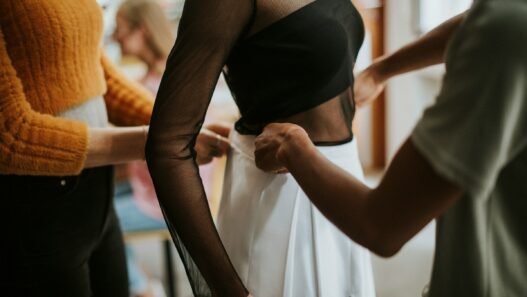
You can follow every guideline above perfectly and still look off if your clothes don’t fit your actual body. A pair of wide-leg pants is great in theory for a heart shape, but if the waist gaps, the crotch sags, and the hem drags, none of that matters.
Fit is about whether the garment is constructed correctly for your measurements. It has nothing to do with size labels.
Proportion is about how the pieces you’re wearing relate to each other and to your body. A cropped top works differently on a 5’2″ frame than a 5’9″ one, and neither is wrong. It’s just math.
When you invest in tailoring or take the time to actually try things on instead of ordering based on what looks good on the model, you’ll get more mileage out of a $40 dress than a $400 one that doesn’t fit right.
The shape categories are a roadmap. But the destination is clothes that fit your body, not the other way around.
Still figuring out your shape? Stand in front of a mirror in fitted clothing (think: a tank and leggings) and look at where your width is. Are your shoulders and hips roughly even? Do you carry width at the hips or the chest? Is your waist defined or straight across? That’s your starting point.